
Almost nobody calls the police by their actual job title in casual conversation. Depending on where you live, you’ve probably heard them called cops, the fuzz, five-o, or a dozen other things, and most of these nicknames have a real story behind them, even when that story is a little murky.
This guide walks through the most common police nicknames used across the English speaking world, what they actually mean, and where each one is believed to have come from. A few carry a friendly, almost playful tone. Others grew out of real tension between police and the communities they serve. Both kinds are worth understanding.
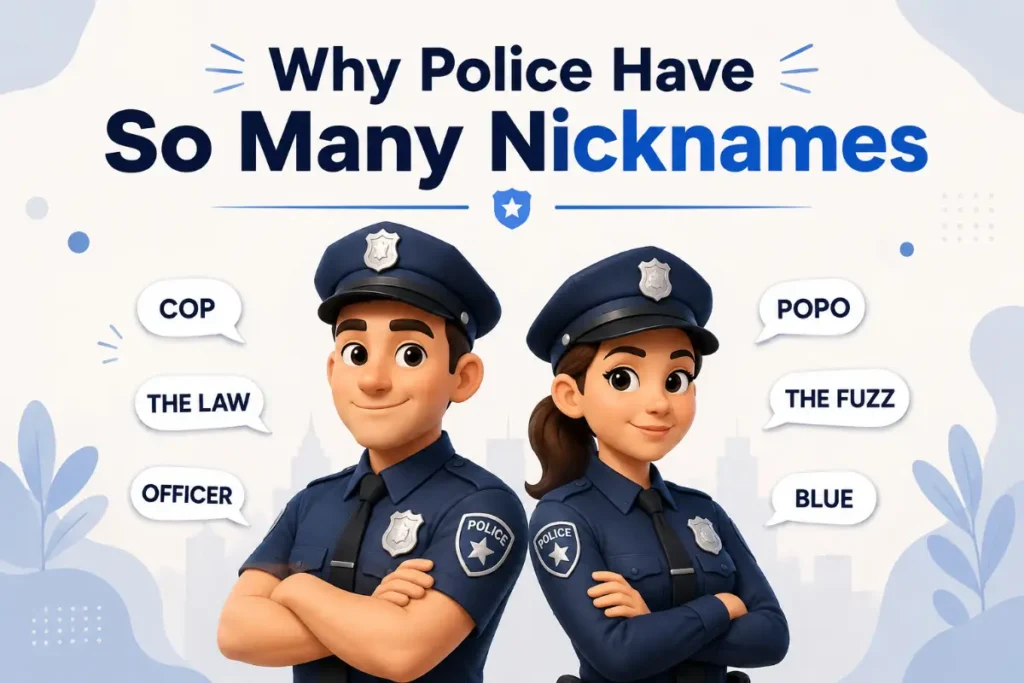
Why Police Have So Many Nicknames
Slang for police tends to come from two very different directions. <cite index=”31-1″>Some nicknames come from the public, used to describe or sometimes warn about police, while others come from inside law enforcement itself, built out of everyday shorthand officers use on the job.</cite> That split explains why the list below ranges from lighthearted television references to internal radio codes that only make sense to someone already wearing the uniform.
Cop And Copper
This is the oldest and most common nickname on the list by a wide margin. <cite index=”32-1″>Cop is believed to come from the 19th century verb to cop, meaning to seize or arrest, and as people began describing an arrest as being copped, the officers doing the arresting naturally became known as coppers.</cite> <cite index=”33-1″>That usage of to cop actually dates back as far as 1704, long before organized police forces even existed.</cite>
A popular myth claims copper comes from copper buttons on old police uniforms, but <cite index=”33-1″>that explanation isn’t accurate. The word is tied to the older verb meaning to catch or seize rather than anything to do with uniform buttons.</cite> Today, cop is so common that even officers use it casually to describe their own profession.
The Fuzz
<cite index=”29-1″>The fuzz became popular slang during the 1960s and 70s, though its exact origin is genuinely unclear even among language historians.</cite> A few competing theories exist. <cite index=”29-1″>One suggests it comes from the static sound heard over police radios, another points to the somewhat fuzzy looking hats worn by British police officers, and a third theory connects it to the short, fuzzy haircuts new officers had right out of the academy.</cite> Some researchers have also floated the idea that it’s simply a strange abbreviation of the force.
Five-O
<cite index=”28-1″>Five-O comes directly from the television show Hawaii Five-O, a police drama that first aired in 1968 and became one of the most popular crime shows of its era.</cite> <cite index=”32-1″>In the show, five-o referred to a fictional Hawaiian police unit, based on Hawaii being the fiftieth state admitted to the United States.</cite> Despite that detail being fictional, since real Hawaiian police never used that designation, the nickname spread across the mainland United States and is still widely used today, often as a warning that police are nearby.
The Heat, Po-Po, And Boys In Blue
A handful of other American nicknames are common enough to be instantly recognizable, even if their origins are less documented. <cite index=”31-1″>The Heat, Po-Po, and Boys In Blue are all widely used terms for law enforcement across the United States, alongside other common nicknames like the feds, G-men, and narcs.</cite> Po-po is generally believed to come from a simple repetition of the word police, while Boys In Blue refers directly to the traditional blue color of American police uniforms.
Pigs And Other Controversial Nicknames
Not every police nickname is lighthearted. <cite index=”34-1″>Pigs is a derogatory term for police officers with unclear exact origins, though it has been documented in use since at least the 1960s, particularly during periods of civil unrest and protest.</cite> Unlike playful nicknames like the fuzz or five-o, this term carries real tension and reflects a specific era of strained relations between police and certain communities. It remains one of the more polarizing entries on any list of police slang, seen by some as harmless and by others as genuinely disrespectful.
Smokey And Barney
A couple of American nicknames come straight out of pop culture and carry a lighter, more regional feel. <cite index=”28-1″>Smokey refers to the wide brimmed hats worn by state troopers, resembling the hat worn by the Smokey Bear forest fire prevention mascot, and the term existed well before the 1977 movie Smokey and the Bandit popularized it further.</cite> <cite index=”28-1″>Barney comes from Barney Fife, the bumbling deputy played by Don Knotts on The Andy Griffith Show, and is generally used to describe an officer seen as inept or overly excitable.</cite>
British And Commonwealth Terms For Police
Outside the United States, police slang takes on its own regional flavor. In the United Kingdom, officers are commonly called Bobbies or Peelers, both nicknames tracing back to Sir Robert Peel, who founded London’s Metropolitan Police in 1829. Bobby comes from a familiar shortening of Robert, while Peeler references Peel’s surname directly.
<cite index=”31-1″>In Canada, Mounties is the most widely recognized nickname for members of the Royal Canadian Mounted Police, shortened from mounted, referring to how these officers historically patrolled on horseback.</cite> <cite index=”31-1″>In France and a few other countries, Gendarmes is used for armed police officers, taken from the Old French phrase gens d’armes, meaning men at arms, and it’s occasionally used in American English as a slightly formal or playful nickname for police as well.</cite>
Police Radio Codes And Internal Jargon
Officers also use their own internal shorthand, separate from any nickname the public might use. <cite index=”31-1″>Ten codes like 10-4, meaning an affirmative response such as yes or I understand, originated in the 1920s and were used primarily by law enforcement along with early CB radio users.</cite> This kind of jargon exists for practical reasons, allowing officers to communicate quickly and clearly during high pressure situations, and it’s a very different category from nicknames used by the general public.
Complete List Of Common Police Nicknames
Here’s a quick reference covering the most well documented police nicknames and what each one actually refers to.
| No. | Nickname | What It Refers To |
|---|---|---|
| 1 | Cop | From an old verb meaning to seize or arrest |
| 2 | Copper | An expanded version of cop, same origin |
| 3 | The Fuzz | Origin debated, popular from the 1960s onward |
| 4 | Five-O | From the television show Hawaii Five-O |
| 5 | The Heat | Common American slang for police |
| 6 | Po-Po | Likely a repetition of the word police |
| 7 | Boys In Blue | References traditional blue police uniforms |
| 8 | Pigs | A derogatory term with roots in 1960s civil unrest |
| 9 | Smokey | References the wide brimmed hats worn by state troopers |
| 10 | Barney | From the bumbling deputy on The Andy Griffith Show |
| 11 | Bobbies | British nickname from Sir Robert Peel |
| 12 | Peelers | Another British nickname from Robert Peel’s surname |
| 13 | Mounties | Canadian nickname for the Royal Canadian Mounted Police |
| 14 | Gendarmes | French term for armed police officers |
| 15 | G-Men | American slang, especially associated with federal agents |
| 16 | Narcs | Slang specifically for narcotics officers |
Why These Nicknames Persist
Police nicknames survive because they’re deeply tied to how ordinary people talk about authority. <cite index=”33-1″>Neutral terms like officer maintain a certain professional distance, while nicknames carry a different tone entirely, reflecting how a specific community or generation actually views law enforcement.</cite> That’s part of why some nicknames feel affectionate while others carry real weight. Language around police has always mixed genuine respect, wary distance, and outright criticism, and these nicknames capture all three depending on who’s using them.
Frequently Asked Questions
What is the most common nickname for police?
Cop is by far the most widely used nickname for police officers, so common that it’s used casually even by officers themselves.
Where does the word cop actually come from?
Cop is believed to come from an old verb meaning to seize or arrest, dating back centuries before modern police forces existed.
Why are police called five-o?
The nickname comes from the television show Hawaii Five-O, which aired starting in 1968 and became a major pop culture influence on police slang.
What does the fuzz mean?
The fuzz is a slang term for police that became popular in the 1960s and 70s. Its exact origin is unclear, with several competing theories.
Is calling police pigs considered offensive?
Yes, generally. Unlike more lighthearted nicknames, pigs carries a genuinely derogatory history rooted in periods of civil unrest and tension between police and certain communities.
What do the British call police officers?
Bobbies and Peelers are the two most common British nicknames, both tracing back to Sir Robert Peel, who founded London’s Metropolitan Police.
What is a Mountie?
Mountie is the common nickname for a member of the Royal Canadian Mounted Police, referring to their historical use of mounted horse patrols.
Final Thoughts
Police nicknames reveal a lot about how language absorbs history, pop culture, and public sentiment all at once. Some, like five-o and Smokey, trace back to specific television shows and everyday details of the job. Others, like pigs, carry real historical tension that’s worth understanding rather than glossing over. Whichever nickname you’ve heard most, there’s almost always a specific, traceable reason it caught on in the first place.
