
If you have come across brumeblog.com while searching for information online, you may be wondering what the website offers and if its articles are worth reading. BrumeBlog is a general interest blog that publishes content across several subjects, including business, technology, education, finance, health, lifestyle, and travel. It gives readers a place to explore different topics without visiting a separate website for every question. However, its wide range of subjects also means readers should check the quality of each article before relying on its advice. brumeblog.com+1
This review looks at the website’s content, main features, potential benefits, limitations, and safety considerations. It also explains how to decide when a general blog is useful and when an official or specialist source is a better choice.
What Is BrumeBlog.com
BrumeBlog is a multi topic publishing website designed for people who want to read about different subjects in one place. Rather than focusing on a single area, it publishes articles covering everyday questions, practical guides, business topics, technology, and other areas of general interest.
The website’s public homepage displays articles with titles, publication dates, author names, and topic categories. Examples include content about international child custody, cybercrime laws, product inspection for online sellers, billboard advertising, and private real estate financing. This mix shows that the site covers both everyday interests and more specialized subjects. brumeblog.com
The broad approach can be helpful when you want an introduction to an unfamiliar topic. You might visit to learn a basic business concept, understand a technology term, or explore a lifestyle question. You can then decide if you need more detailed information from another source.
Still, a website that covers many topics is not automatically an expert source in every field. The quality of an article depends on its research, the writer’s knowledge, the accuracy of its claims, and the way it handles important details.
For that reason, it is best to view BrumeBlog as a starting point for general reading rather than a replacement for professional guidance or trusted reference materials.
What Topics Does BrumeBlog Cover
One of the website’s main features is its variety of content. Readers with different interests can explore different sections without needing to learn a new website layout each time.
Business
The business section can appeal to entrepreneurs, employees, marketers, and people interested in how companies operate. Topics may include marketing methods, business planning, product quality, financing, and practical decisions that affect organizations.
For example, a small business owner might look for information about product inspection before shipping goods to a warehouse. A marketing student might want to understand why traditional advertising methods still attract attention.
Articles like these can help readers learn the basics and identify questions worth exploring. However, business decisions often depend on industry rules, costs, contracts, and local conditions. Always check important details before spending money or changing a business process.
Technology
Technology content helps readers explore digital tools, online services, software, and common technical questions. This category can be useful for beginners who want an explanation without too much technical language.
Technology changes quickly, though. A guide that was accurate several months ago may no longer match the latest software version or security advice. Check the publication date and compare instructions with the official website of the product or service involved.
Education
Educational articles can help readers understand unfamiliar terms, research subjects, and practical learning questions. Students may use general guides to build background knowledge before reading textbooks or consulting academic resources.
For school assignments, research papers, or professional training, treat general blog articles as supporting material. Check original sources and follow any citation rules set by your teacher or institution.
Finance
Financial content may discuss money management, investment concepts, trading, and other money related topics. These subjects attract readers who want to understand unfamiliar financial terms before making a decision.
There is an important limit here. A general article cannot account for every reader’s income, debts, goals, tax situation, or tolerance for risk. Never make a major investment or financial commitment based on a single blog post.
For current rules and personal financial decisions, consult relevant government resources, official financial institutions, or a qualified professional.
Health
Health articles can introduce wellness topics and explain common health questions in everyday language. This type of content may help readers prepare questions for a doctor or understand basic terminology.
However, health information needs extra care. An article may not reflect your personal medical history, medications, symptoms, or other needs. For diagnosis and treatment, rely on qualified health professionals and recognized medical sources.
Lifestyle and Travel
Lifestyle and travel articles can offer ideas, planning tips, and general guidance for daily life or future trips. Readers might explore a new destination, learn about a common lifestyle topic, or look for ways to organize a task.
Before booking travel, confirm visa rules, entry requirements, prices, opening hours, and local guidance through official sources. These details can change, and an older article may not reflect current conditions.
Main Features of BrumeBlog
A website’s value depends on more than the number of topics it covers. Navigation, readability, access, and the way articles present information also affect the reader’s experience.
A Wide Range of Articles
BrumeBlog brings different subjects together on one platform. This is useful for readers whose interests change from day to day.
You might start with a business article and later explore technology or travel. Having several categories in one place makes casual browsing easier and may introduce you to subjects you had not planned to explore.
The tradeoff is that broad coverage can make it harder for a publication to build deep expertise in every subject. Readers should judge individual articles on their own merits.
Category Based Browsing
Topic categories help readers find content that matches their interests. Instead of scanning every article on the homepage, visitors can focus on a relevant subject.
This structure is familiar to anyone who has used an online magazine or blog. Clear categories can reduce the time it takes to find a useful article, especially for readers who are exploring a topic for the first time.
Readable Article Format
General interest websites often use headings, short sections, and simple explanations to make information easier to scan. This format can help readers identify the main points without reading every paragraph.
A well organized article should answer the main question early, explain unfamiliar terms, and provide useful context. If a page uses many headings but offers little evidence or practical detail, its structure alone does not make it reliable.
Publicly Accessible Content
The public homepage displays articles that visitors can open and read. This makes the site convenient for casual browsing. brumeblog.com+1
Before sharing personal information or creating an account on any website, check the page carefully. Ordinary reading does not require you to provide sensitive details, and you should be cautious if a page unexpectedly asks for payment information or personal data.
Different Reading Interests in One Place
Some readers prefer specialist websites for every subject. Others enjoy browsing a digital magazine that covers a wider range of interests.
BrumeBlog’s multi topic format may suit the second group. It offers a single place to discover articles across different areas, although readers looking for detailed technical or professional guidance may need more focused sources.
Is BrumeBlog Legitimate
A useful review should separate what can be observed from what cannot be confirmed. A website can publish real articles and still have gaps in transparency, editorial standards, or subject expertise.
The public homepage shows published articles, dates, author bylines, and topic categories. These are useful signs that the site operates as a content publication. However, those details alone do not prove that every article is accurate or that every contributor has professional expertise in the subject they cover. brumeblog.com+1
When assessing brumeblog.com, consider these points.
Visible publishing activity. The homepage lists articles across different topics and includes publication dates. This helps readers see the type of material the site publishes.
Author information. Check the byline on an article and look for information about the writer’s background. A name by itself does not establish expertise. For medical, legal, financial, or technical subjects, relevant qualifications and experience matter.
Editorial transparency. Look for clear information about the publisher, contact details, corrections, and editorial policies. These details help readers understand who is responsible for the content and how mistakes are handled.
Sources and evidence. Reliable articles should support important claims with trustworthy references, direct evidence, or links to original sources. Broad statements without supporting information deserve closer review.
Consistency across articles. A well researched article does not prove that every other post on the same website meets the same standard. Evaluate the specific page you plan to use.
Based on the visible material, BrumeBlog functions as a general content website. The available public information does not justify treating every article as expert reviewed or assuming that the entire site has been independently verified. A careful reader should check the evidence behind each important claim.
Is BrumeBlog Safe to Visit
Website safety involves more than deciding if a publication looks professional. It includes the site’s technical security, the links it contains, the information it requests, and the actions a visitor takes.
Reading a public article is different from downloading a file, installing software, entering payment details, or sharing private information. Each activity carries a different level of risk.
There is not enough evidence from the homepage alone to guarantee that every page, link, or future interaction is safe. Use normal online safety practices when visiting any unfamiliar website.
Check the Website Address
Make sure the address in your browser is the domain you intended to visit. Look carefully for extra words, unusual spelling, or small changes that could indicate a different website.
This is especially important when searching for a website by name. Similar looking domains may belong to separate operators and should not automatically be treated as the same publication.
Look for HTTPS
HTTPS helps protect information exchanged between your browser and a website. It is a useful security feature, but it does not prove that a website’s content is honest or accurate.
Scam websites can also use HTTPS. Consider it one part of a wider safety check rather than proof of trustworthiness.
Avoid Unexpected Downloads
Be cautious if an article or advertisement asks you to install an unknown application, browser extension, or file to continue reading. Do not download software simply because a page says it is required.
If you need a tool mentioned in an article, visit the developer’s official website and verify the product before installing anything.
Protect Personal and Payment Information
A general information article should not normally need your bank details, passwords, or government identification. Never provide sensitive information to an unfamiliar page without a clear and verified reason.
If a page requests payment, review the service, its terms, refund policy, and the identity of the seller before proceeding.
Use Trusted Security Tools
You can check suspicious links with established security services, such as Google Safe Browsing or VirusTotal. These services can provide useful signals about known threats, but a clean result does not guarantee that a website is completely safe.
Safety verdict: Basic precautions are appropriate. The available information is not enough to make a blanket guarantee about every page on BrumeBlog. Browse carefully, avoid unnecessary downloads, and do not share sensitive information without a clear reason.
Advantages and Disadvantages of BrumeBlog
A balanced assessment helps you decide if the site fits your needs. The same features that make a general interest blog convenient can also create limitations.
Potential Advantages
Variety of subjects. Readers can explore business, education, finance, health, lifestyle, technology, and travel content in one place.
Accessible reading. General interest articles can introduce topics in a way that feels less demanding than a technical manual or academic paper.
Easy topic discovery. Categories and article listings make it possible to browse beyond a single search question.
Useful starting points. An introductory article can help readers understand basic terms and discover what they need to research next.
Convenience. A multi topic publication may save time when you want a quick overview rather than a specialist report.
Potential Disadvantages
Uneven subject expertise. A broad publication may not offer the same depth as a dedicated medical, legal, financial, or technical resource.
Limited proof of editorial standards. Readers should look for clear evidence of fact checking, author qualifications, and correction practices instead of assuming these processes exist.
Information can become outdated. Technology, regulations, health guidance, and financial conditions may change after an article is published.
Research quality may vary. The value of each page depends on its evidence, clarity, and accuracy.
Not ideal for every decision. A general blog should not be your only source for decisions that could affect your health, money, legal rights, or personal safety.
These limitations do not mean the website has no value. They show why readers should match the source to the importance of the question they are trying to answer.
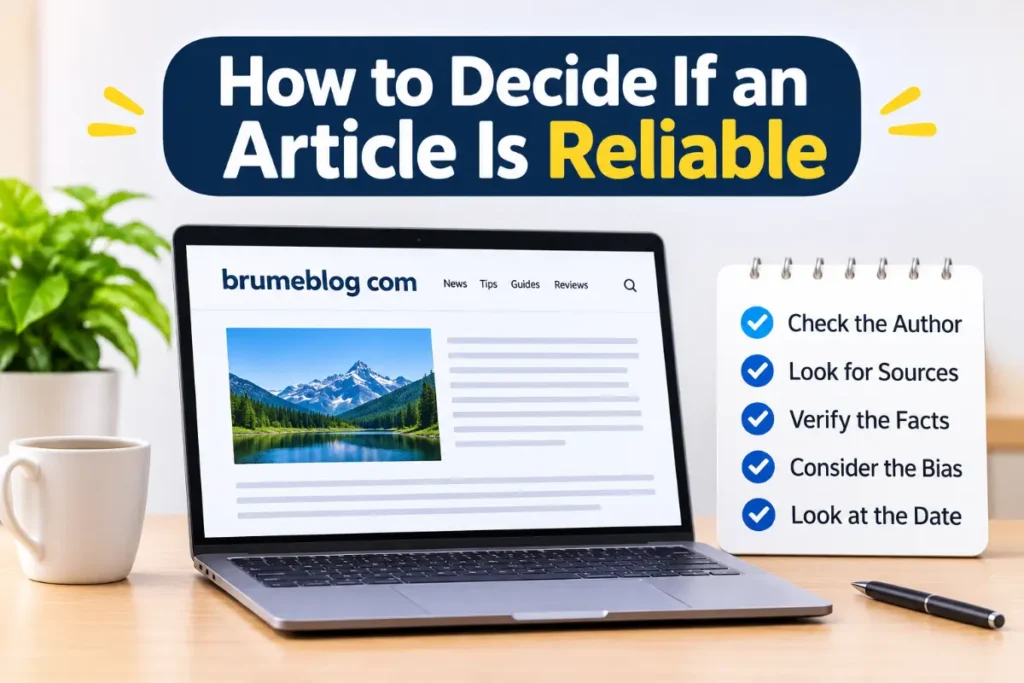
How to Decide If an Article Is Reliable
You do not need to be a professional researcher to spot common signs of a weak article. A few simple checks can help you separate useful information from claims that need more support.
Check the Publication Date
Start by looking at when the article was published or updated. A recent date does not automatically make a page accurate, but an old date can be important for subjects that change quickly.
For example, a software guide may describe an interface that no longer exists. A tax article may discuss rules from a previous year. A travel guide may list entry requirements that have since changed.
Look for confirmation from an official source when timing matters.
Read Beyond the Headline
Headlines are designed to attract attention, so they may simplify a complicated issue. Read the article itself before deciding what it claims.
Ask yourself if the body answers the main question, explains important limits, and provides enough context to support its conclusion. If the headline promises a complete answer but the article gives only general statements, look elsewhere.
Review the Author
Check if the author has relevant experience or qualifications. For everyday topics, a clear and accurate explanation may be enough to help you get started. For specialist subjects, professional knowledge becomes more important.
If an article gives medical advice, for example, look for reliable medical references and confirm the information with a qualified health professional when it could affect your care.
Follow the Sources
Good research should make important claims easier to verify. Follow links to official documents, original studies, government guidance, or other primary sources.
Do not assume a claim is accurate just because several blogs repeat it. Those pages may all rely on the same unverified statement.
Compare Important Claims
Search for the same claim on a trusted specialist website. If two sources disagree, investigate the reason instead of choosing the one that sounds more convincing.
For US readers, government websites can be useful for official rules and public information. Universities, recognized professional organizations, and established specialist publications can also help, depending on the subject.
Watch for Overconfident Language
Be careful with articles that promise guaranteed results, claim there is no risk, or present complicated questions as having one simple answer.
Reliable information usually explains what is known, what remains uncertain, and which factors may change the outcome.
BrumeBlog Compared With Specialist Websites
A general blog and a specialist website serve different purposes. BrumeBlog can help you discover a topic, but a focused source may be more useful when you need detailed facts, current rules, or professional guidance.
| Your goal | Best type of source |
|---|---|
| Understand an unfamiliar topic | A clear introductory blog article |
| Confirm a US law or government rule | An official government website |
| Research a medical concern | A recognized medical source or qualified clinician |
| Learn about an investment | Official financial disclosures and qualified financial guidance |
| Fix a software problem | The software developer’s official documentation |
| Complete academic research | Peer reviewed studies and reputable academic sources |
| Plan a trip | Official destination and transportation websites |
For example, if you find an article about US tax requirements on brumeblog.com, use it to understand the general subject. Then confirm the current rules through the Internal Revenue Service. If an article discusses online safety, compare its advice with information from CISA.
This approach lets you benefit from accessible explanations without placing too much trust in a single source.
Who Should Read BrumeBlog
BrumeBlog may be useful for readers who enjoy exploring different subjects and want a simple introduction before doing deeper research.
Casual readers may appreciate the range of topics available on one website. They can browse articles based on curiosity rather than following a single subject.
Beginners may find general explanations helpful when learning unfamiliar terms. A straightforward introduction can make a complicated subject easier to understand.
Students can use general articles to build background knowledge, provided they verify facts and use appropriate sources for assignments.
Small business owners may find ideas about marketing, operations, and business planning that lead to further research.
Readers comparing sources can use the site as one point of reference while checking the same subject through official or specialist publications.
However, readers who need professional analysis, verified research, or highly specialized guidance should not depend on a general blog alone. The more important the decision, the more carefully you should verify the information.
How to Get More Value From the Website
A few practical habits can make your reading more productive.
1. Start with a clear question. Know what you want to learn before opening an article. This makes it easier to judge if the page answers your needs.
2. Scan the headings. Look at the article structure to see if it covers the main points you need.
3. Check the date and author. These details help you understand the context and assess the writer’s background.
4. Look for evidence. Give more weight to specific facts supported by reliable sources than to broad claims without proof.
5. Verify important details. Use official sources for current laws, medical information, financial rules, and technical instructions.
6. Keep track of useful sources. Bookmark pages that provide reliable information and return to the original references when you need to confirm a fact.
7. Avoid sharing sensitive data. Reading an article should not require you to reveal passwords, banking information, or other private details.
These habits work for almost any information website. They also help you become a more confident reader who can judge information instead of accepting every statement at face value.
Frequently Asked Questions
What is brumeblog.com?
brumeblog.com is a general interest blog that publishes articles across several categories, including business, education, finance, health, lifestyle, technology, and travel. It is designed for readers who want to explore a variety of subjects.
Is BrumeBlog free to read?
The public website displays articles that visitors can open and read. Check the individual page for any changes in access requirements before sharing personal information or making a payment.
Is BrumeBlog a scam?
The available public information does not establish that the website is a scam. Its visible homepage contains articles, author names, dates, and topic categories. However, these details alone cannot prove every claim about the site or guarantee the accuracy of all its content.
Is BrumeBlog safe to visit?
Use ordinary online safety precautions when visiting the site. Check the domain, avoid suspicious downloads, and do not provide sensitive information without a clear reason. No assessment based on a homepage alone can guarantee that every page or link is safe.
Can I trust the information published on BrumeBlog?
Treat each article according to its subject and evidence. General explanations may help you learn the basics, but important medical, legal, financial, and technical claims should be confirmed through qualified or official sources.
Does BrumeBlog cover only technology?
No. The website covers several areas, including business, education, finance, health, lifestyle, and travel, in addition to technology. Its broad coverage is one of its main characteristics.
Who is BrumeBlog best for?
It may suit casual readers, beginners, and people looking for a starting point on an unfamiliar subject. Readers who need expert level research or professional advice should consult more specialized sources.
Should I use BrumeBlog as my main research source?
That depends on the topic. It may be enough for casual reading or an introductory overview. For academic work, important purchases, health decisions, financial choices, or legal questions, compare the information with trusted primary sources.
Final Verdict
BrumeBlog is a multi topic content website that brings together articles about business, technology, education, finance, health, lifestyle, travel, and other areas. Its broad subject range can make it a convenient place to discover new topics and get a basic understanding of unfamiliar questions.
Its biggest strength is variety. Instead of visiting a different blog for every interest, readers can browse multiple categories on one platform. That can be helpful when the goal is casual reading or an initial overview.
The main limitation is that broad coverage does not automatically prove specialist expertise. Readers should examine the quality of each article, check publication dates, review author information, and follow reliable sources before acting on important claims.
Overall, brumeblog.com is best approached as a starting point for general information rather than a final authority on every subject. Read it with a critical eye, verify high stakes information, and use specialist resources when accuracy matters most. That way, you can explore the website while making informed decisions about what deserves your trust.

Saima Basheer writes about websites, online tools, and digital services, focusing on what makes each platform useful and worth exploring. Her goal is to provide clear, reader-friendly reviews that help people discover practical online resources and choose the options that best suit their needs.