
French has one of the most famously quirky traditions of pet names in the world, built heavily on food and animals rather than the flowery language you might expect. Calling someone your little cabbage or your flea sounds strange in English, but in French these are some of the warmest things you can say to someone you love. If you’re curious about French nicknames, you’re looking at a language where affection often comes wrapped in produce and barnyard animals.
This guide breaks down the most common French nicknames, organized by how they’re actually used, from safe, universal terms for a partner to the playful food and animal names French parents use with their kids. Each one comes with its real meaning and a note on who it typically gets used for.
The Story Behind French Nicknames
French terms of endearment lean heavily on food and animals, and while that sounds odd translated word for word, it’s genuinely affectionate once you understand the culture behind it. Mon chou, meaning my cabbage, is one of the most common French nicknames of all, and it likely started as a nod to chou à la crème, a sweet French cream puff, rather than the vegetable itself.
What makes French nicknames especially interesting is how widely they get used. Unlike some languages where pet names stay strictly private between couples, plenty of French nicknames show up constantly between parents and children, close friends, and even shopkeepers greeting regular customers. A term like ma belle or mon chou carries no romantic weight at all when said to a child or a friend.
How French Grammar Shapes These Nicknames
French nicknames follow a specific grammar rule that trips up a lot of learners. That’s why a man can call his girlfriend mon amour, since amour is a masculine noun, even though she’s a woman, and why anyone can call a male friend ma puce, since puce is a feminine noun.
Most terms can also be made even cuter by adding petit or petite, meaning little, in between the mon or ma and the noun itself. That’s how mon chou becomes mon petit chou, and how ma biche becomes ma petite biche, adding an extra layer of warmth to an already affectionate word.
Classic French Terms Of Endearment
These are the safest, most universal French nicknames, appropriate in almost any warm, affectionate context.
| No. | Nickname | Meaning |
|---|---|---|
| 1 | Mon amour | My love, works for anyone regardless of gender |
| 2 | Mon chéri / Ma chérie | My darling, one of the most universally used French terms |
| 3 | Mon cœur | My heart, deeply affectionate and safe in most situations |
| 4 | Mon ange | My angel, used for both partners and children |
| 5 | Mon trésor | My treasure, used for anyone cherished deeply |
| 6 | Ma belle / Mon beau | My beautiful, my handsome |
| 7 | Mon bébé | My baby, can be said to almost anyone you care for |
| 8 | Ma moitié | My other half, used for a spouse or very close friend |
| 9 | Mon cher / Ma chère | My dear, more formal and respectful than romantic |
| 10 | Mon étoile | My star, poetic without being overly flowery |
Romantic French Nicknames For A Partner
Slightly more intimate terms reserved for a romantic relationship.
| No. | Nickname | Meaning |
|---|---|---|
| 1 | Mon amour | My love |
| 2 | Mon cœur en sucre | My heart made of sugar, a sweetened version of mon cœur |
| 3 | Ma princesse | My princess, used for a partner or a daughter |
| 4 | Mon prince | My prince, used for a partner or a son |
| 5 | Ma reine | My queen |
| 6 | Mon roi | My king |
| 7 | Mon amoureux / Mon amoureuse | My lover, though sometimes also used playfully with children |
| 8 | Ma perle | My pearl |
| 9 | Mon homme | My man |
| 10 | Ma louloute / Mon loulou | My darling, often used in a soft, singsong tone |
French Nicknames Inspired By Food
Food based nicknames are some of the most distinctively French pet names of all.
| No. | Nickname | Meaning |
|---|---|---|
| 1 | Mon chou | My cabbage, likely tied to a French cream puff pastry |
| 2 | Mon petit chou | My little cabbage, an even cuter version |
| 3 | Chouchou / Chouchoute | A doubled, extra affectionate version of chou |
| 4 | Ma crevette | My little shrimp, used for daughters |
| 5 | Mon bonbon | My candy |
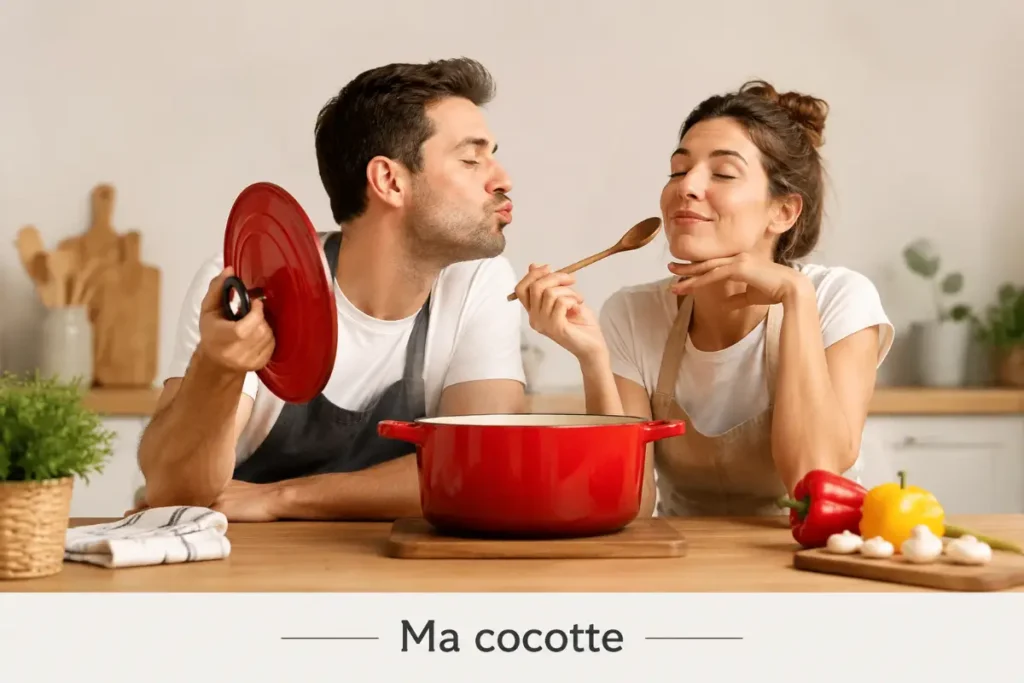
| 6 | Ma cocotte | My little casserole dish, a playful term used for women and children |
| 7 | Mon petit pot de miel | My little pot of honey |
| 8 | Ma crotte | My poo, a genuinely silly but sweet nickname despite the blunt translation |
French Nicknames Inspired By Animals
Animal based nicknames show up constantly in French, especially for children and partners.
| No. | Nickname | Meaning |
|---|---|---|
| 1 | Ma puce | My flea, one of the most common and beloved French nicknames |
| 2 | Mon lapin | My rabbit, used for partners, children, and close friends |
| 3 | Mon poussin | My chick, referring to a baby chicken |
| 4 | Ma biche | My deer, a classic and gentle term |
| 5 | Mon canard | My duck |
| 6 | Mon chat / Ma chatte | My cat, used for both genders |
| 7 | Mon minou | My kitty |
| 8 | Mon oisillon | My little bird |
| 9 | Ma cocotte | My little hen, also doubling as a food related term |
| 10 | Mon biquet | My little goat, meaning something closer to my lamb |
French Nicknames For Children
Softer, gentler nicknames that French parents use constantly with kids.
| No. | Nickname | Meaning |
|---|---|---|
| 1 | Mon petit chou | My little cabbage, one of the most common nicknames for kids |
| 2 | Mon poussin | My chick |
| 3 | Ma puce | My flea, extremely common for young children |
| 4 | Mon doudou | My cuddly thing, referencing a child’s favorite stuffed animal or blanket |
| 5 | Mon bout de chou | Literally my bit of cabbage, meaning something like my little one |
| 6 | Mon grand / Ma grande | My big one, used to praise a child affectionately |
| 7 | Bambin | Toddler, used playfully for a young child |
| 8 | Ma louloute / Mon loulou | My darling, almost exclusively used with children |
| 9 | Ma cocotte | My little hen |
| 10 | Mon trésor | My treasure |
French Nicknames For Friends
Not every French nickname carries romantic weight. Plenty are common between close friends too.
| No. | Nickname | Meaning |
|---|---|---|
| 1 | Mon pote | My buddy, a common casual term between male friends |
| 2 | Ma belle | My beautiful, common between close female friends |
| 3 | Mon chou | My cabbage, frequently used platonically |
| 4 | Ma cocotte | My little hen, common and warm between friends |
| 5 | Frérot | Little brother, used casually for a close male friend |
| 6 | Ma puce | My flea, sometimes used between close friends |
| 7 | Doudou | Sometimes used affectionately for a close friend, especially in French speaking African and Caribbean communities |
French Nicknames For Grandparents
Warm, often bilingual sounding titles for grandparents in French families.
| No. | Nickname | Meaning |
|---|---|---|
| 1 | Papy | Grandpa |
| 2 | Mamy | Grandma |
| 3 | Papi | An alternate spelling of Papy |
| 4 | Mami | An alternate spelling of Mamy |
| 5 | Grand’pa | A borrowed, anglicized version of grandpa |
| 6 | Grand’ma | A borrowed, anglicized version of grandma |
| 7 | Pap’s | A modern, shortened twist on Papy |
| 8 | Mam’s | A modern, shortened twist on Mamy |
| 9 | Poupou | Used more generally for a beloved older relative |
| 10 | Poupée | Literally doll, used affectionately in a similar way |
How To Use These Nicknames The Right Way
The biggest thing to understand about French nicknames is how much relationship and context shape which one fits. Mon amour, mon chéri, and mon cœur are safe almost anywhere in a romantic relationship, while something like ma puce or mon petit chou works beautifully with children or a very close partner but would feel strange directed at a coworker or new acquaintance.
Formality matters too. Mon cher and ma chère look similar to mon chéri and ma chérie but carry a completely different meaning, closer to a respectful dear than a romantic darling, and French speakers rarely use them with actual friends. Getting that distinction backward is one of the most common mistakes non native speakers make.
It also helps to remember that French nicknames are endlessly customizable. Since petit and petite can be added to almost any term, and since the food and animal categories are so large, French speakers regularly build entirely personal nicknames rather than sticking to a fixed list.
Frequently Asked Questions
What is the most common French nickname for a partner?
Mon amour, meaning my love, is generally considered the most common and universal French nickname for a romantic partner.
What does mon chou mean in French?
Mon chou literally means my cabbage, though it likely traces back to chou à la crème, a French cream puff, making it closer in spirit to calling someone sweetie or pumpkin.
Are French nicknames only used for romantic partners?
No. Many, including mon chou, ma puce, and ma cocotte, are commonly used with children, family members, and close friends as well.
What does ma puce mean in French?
Ma puce literally means my flea, but it’s one of the warmest and most common French nicknames, used affectionately for children, partners, and sometimes close friends.
Why do so many French nicknames come from food and animals?
French pet name culture has a long tradition of using food and animal imagery to express affection, and while the literal translations sound odd in English, they carry genuine warmth in French.
How does French grammar affect which nickname to use?
The possessive word mon or ma depends on the gender of the noun itself, not the gender of the person being spoken to, which is why terms like mon amour or ma puce can apply to anyone.
What is a good French nickname for a child?
Common options include mon petit chou, mon poussin, and ma puce, all widely used by French parents with young children.
What is the difference between mon cher and mon chéri?
Mon cher and ma chère are more formal, similar to saying dear in a respectful sense, while mon chéri and ma chérie are intimate and romantic, closer to darling.
Final Thoughts
French nicknames reveal a genuinely playful side of a language often associated with romance and formality in equal measure. Some, like mon amour and mon chéri, are safe and universal enough to use almost anywhere. Others, built from France’s love of food and animal imagery, let people express affection in a way that’s specific, a little silly, and completely their own. Whichever one you use, the warmth usually comes through in the tone as much as the word itself.
