
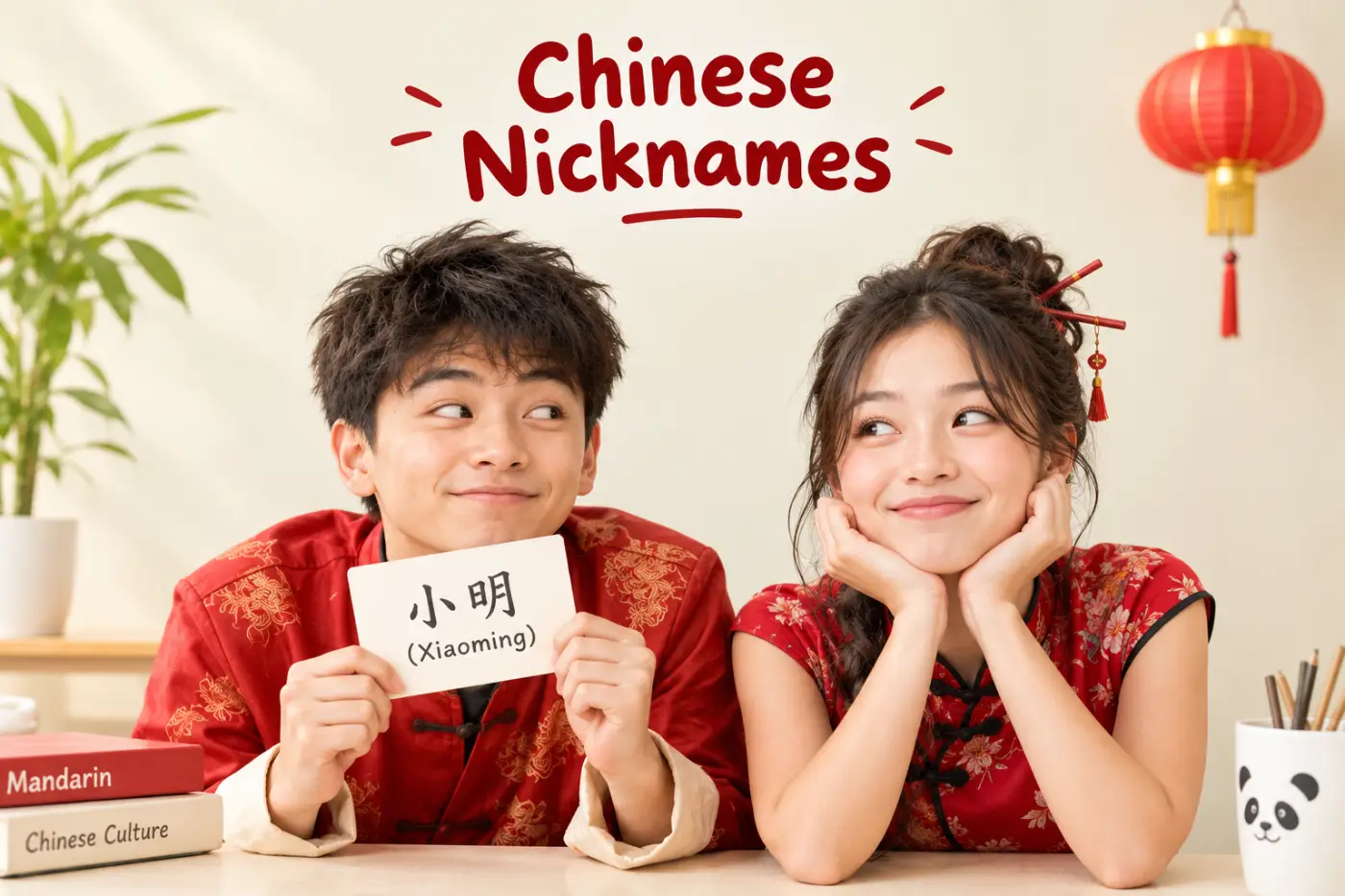
Chinese naming culture treats nicknames as something close to a second identity. Almost everyone grows up with a childhood pet name completely separate from their official name, and that habit continues into adulthood through romantic nicknames, playful nicknames between friends, and respectful terms used for family. If you’re curious about Chinese nicknames, there’s a genuinely deep tradition behind them.
This guide breaks down how Chinese nicknames actually work, the different types that exist, and real examples with their meanings, organized by relationship so you can see how the tradition shows up in everyday life.
The Story Behind Chinese Nicknames
Chinese has several distinct words for what English speakers would lump together as a nickname, and each one means something slightly different. Xiaoming refers to an informal childhood pet name used within the family. Ruming, often translated as an infant name, works almost identically. Chuohao is closer to what English speakers would call a moniker, and it can be affectionate, teasing, or occasionally unkind depending on the relationship.
The tradition of giving children a separate pet name goes back centuries and was originally tied to superstition. Many families believed that evil spirits might try to take a child before they grew old enough to be safe, so parents deliberately chose humble, unglamorous pet names to avoid drawing unwanted attention. That practice has mostly faded today, but the habit of using a completely different name at home stuck around simply because families liked it.
How Xiaoming Childhood Nicknames Are Built
There are a few common patterns families use when creating a child’s pet name. The most common approach takes the final character of someone’s given name and repeats it twice, a process similar to how Alexander becomes Alex or Samantha becomes Sammy in English. A name ending in the character na, for example, might become Nana as a nickname used constantly by parents and grandparents.
Other pet names skip the formal name entirely and draw inspiration from nature instead, producing nicknames like Shitou, meaning stone. Some are built around a hope or wish for the child, like Lele, meaning happy child, while others are based on an observed trait, such as Dongdong for a baby who wiggles and moves constantly. Families with multiple children sometimes name them sequentially instead, using pairs like Dabao and Erbao, meaning first treasure and second treasure.
Common Nickname Prefixes
Beyond the name itself, Chinese nicknames often use a small set of prefixes attached to a surname or a shortened given name. A, Xiao, Da, and Lao are the four most common. Xiao, meaning little or young, is typically used for someone younger, while Lao, meaning old, is used respectfully for someone older, even if the age gap is small. A is a warmer, more casual prefix often used in southern China and among close friends and family.
Romantic Terms Of Endearment
People reserve these nicknames for romantic partners, so using them outside that context can cause confusion.
| No. | Nickname | Meaning |
|---|---|---|
| 1 | Bao Bei | Baby or precious one, one of the most widely used romantic terms |
| 2 | Xiao Bao Bei | Little precious stone, an even softer version of bao bei |
| 3 | Xiao Xin Gan | Little heart and liver, an intense, affectionate term for someone deeply cherished |
| 4 | Qin Ai De | Dearest or beloved, a slightly more formal but still warm romantic term |
| 5 | Lao Gong | Husband or hubby, used affectionately even before marriage in some relationships |
| 6 | Lao Po | Wife or wifey, the female equivalent of lao gong |
| 7 | Tian Mi | Sweetheart, literally meaning sweet as honey |
Nicknames For Friends And Casual Relationships
Chinese friends often use playful insults as nicknames because teasing can show closeness.
| No. | Nickname | Meaning |
|---|---|---|
| 1 | Xiao (Surname) | A casual, friendly nickname for someone younger, using their surname |
| 2 | Lao (Surname) | A respectful but warm nickname for someone older, using their surname |
| 3 | A (Given Name) | A casual, affectionate prefix common in southern China |
| 4 | Da Ye Zhu | Big wild boar, a teasing nickname that only works once genuine affection is already obvious |
| 5 | Huo Ban | Buddy or partner, a casual term for a close friend |

Nicknames Inspired By Nature And Good Wishes
These reflect the older tradition of choosing a child’s pet name based on hopes or natural imagery rather than their formal name.
| No. | Nickname | Meaning |
|---|---|---|
| 1 | Shi Tou | Stone, a simple, grounded nature inspired nickname |
| 2 | Le Le | Happy child, chosen to reflect a wish for joy |
| 3 | Dong Dong | Wiggly or restless, based on an observed baby trait |
| 4 | Da Bao | First treasure, used for the eldest child |
| 5 | Er Bao | Second treasure, used for the second child |
| 6 | Xiao Yu | Little rain, a soft nature based nickname |
| 7 | Tian Tian | Sweet, repeated for emphasis and warmth |
Playful And Pop Culture Inspired Nicknames
Chinese couples and friends sometimes borrow nicknames directly from beloved historical dramas and martial arts novels, especially as a playful, shared joke.
| No. | Nickname | Meaning |
|---|---|---|
| 1 | Huang A Ma | Royal father, a playful nickname borrowed from Qing dynasty dramas |
| 2 | Tai Hou | Queen, often paired with Huang A Ma for a royal themed couple nickname |
| 3 | Xiao Ao Jiang Hu | A nickname borrowed from a classic martial arts novel, often used as a couple’s nickname for the male partner |
| 4 | Dong Fang Bu Bai | The paired nickname from the same novel, typically used for the female partner |
| 5 | Bai Fu Mei | White, rich, and beautiful, a popular slang compliment for a glamorous woman |
How To Use These Nicknames The Right Way
The most important thing to understand about Chinese nicknames is how closely context and relationships shape their use. Families usually reserve childhood pet names for home and avoid them in professional settings, even with close work friends. Romantic terms like bao bei carry real meaning because people reserve them for partners. Using them casually with someone else can send a confusing signal.
It also helps to remember that nickname privileges aren’t automatically mutual. Just because someone calls you by an affectionate or playful nickname doesn’t necessarily mean you can use the same kind of nickname back, especially if there’s a difference in age or seniority. The general rule in Chinese culture is that the closer and more equal the relationship, the more playful or even teasing a nickname can become, but that same playfulness can come across as disrespectful in a more formal or hierarchical relationship.
Frequently Asked Questions
What is a xiaoming in Chinese culture?
A xiaoming is an informal childhood pet name that families use instead of a person’s official given name.
What does bao bei mean?
Bao bei means baby or precious one and is one of the most common Chinese terms of endearment for a romantic partner.
Why did Chinese families traditionally give children unusual pet names?
Many families believed humble or unglamorous pet names helped protect a child from evil spirits, a superstition that shaped naming traditions for generations.
What do the prefixes xiao and lao mean in a nickname?
Xiao means little or young and refers to someone younger. Lao means old and shows respect for someone older, even when the age gap is small.
Can you use a Chinese nickname on someone you just met?
It’s best to avoid it. People usually reserve nicknames, especially childhood or romantic ones, for close relationships. Using one too soon can create confusion or discomfort.
What is a playful Chinese nickname for a couple?
Nicknames borrowed from historical dramas or novels, like Huang A Ma and Tai Hou, are popular playful choices for couples who share that cultural reference.
Final Thoughts
Chinese nicknames reveal just how much relationship and context shape everyday language. A childhood pet name carries decades of family history behind it, a romantic term like bao bei signals real intimacy, and even a playful insult between friends can be a genuine sign of closeness. Understanding which nickname belongs to which relationship is really the heart of how the entire tradition works.
