
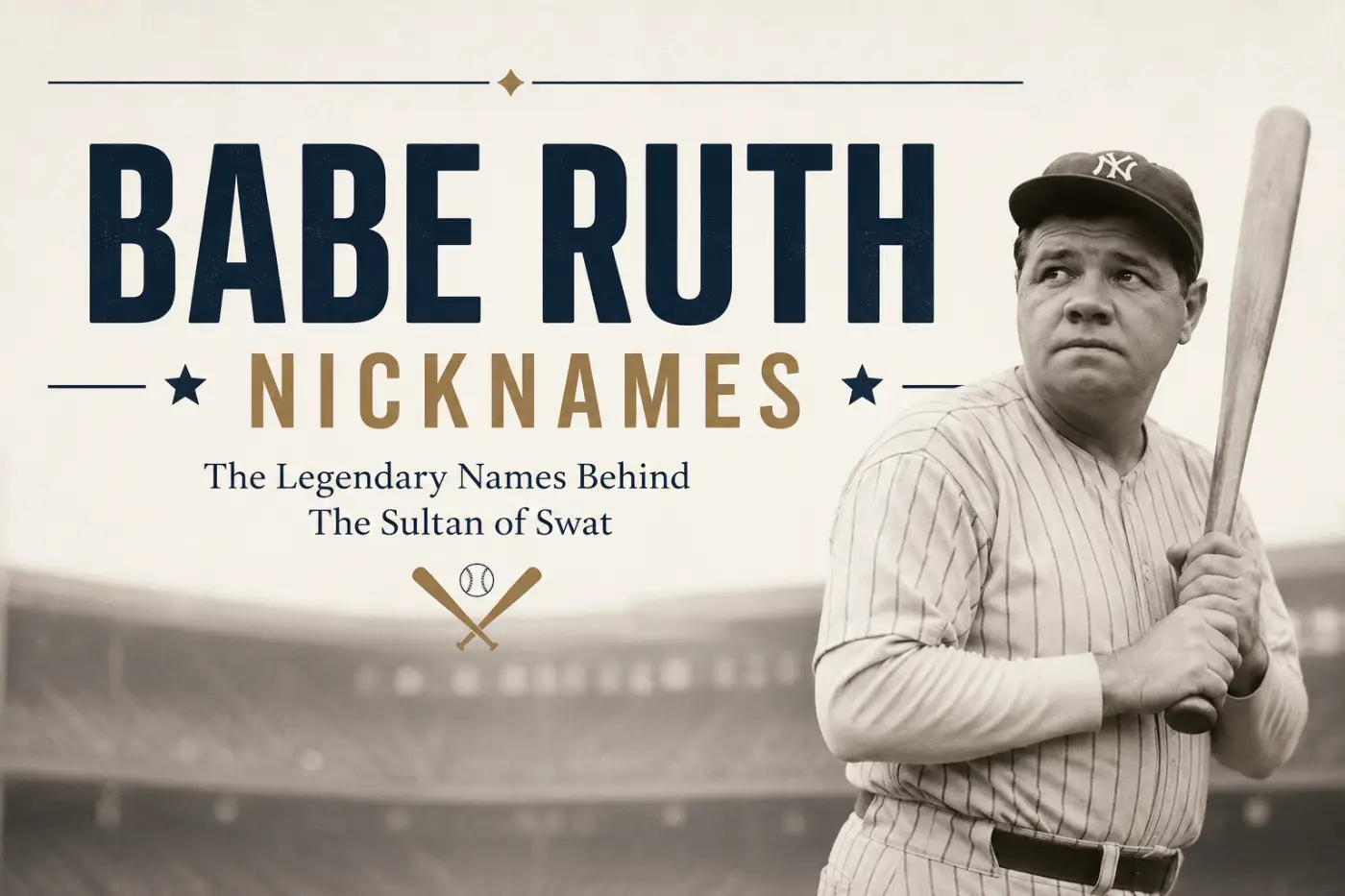
Few athletes in history have collected as many nicknames as Babe Ruth. Long before nicknames became a social media habit, sportswriters, teammates, and fans were already competing to come up with the most colorful way to describe the man who changed baseball forever. Some of his nicknames grew out of real clubhouse moments. Others were pure newspaper theater, built to sell papers in an era when sports journalism loved big, dramatic language.
This guide walks through where Babe Ruth’s most famous nicknames actually came from, what they meant at the time, and how a few of them ended up defining his legacy more than his real name ever did.
Who Was Babe Ruth
Babe Ruth was born George Herman Ruth Jr. in Baltimore, Maryland, and went on to become one of the most dominant hitters and pitchers in Major League Baseball history. He played 22 seasons in MLB from 1914 to 1935, starting as a standout left handed pitcher for the Boston Red Sox before becoming famous as a power hitting outfielder for the New York Yankees. By the time his career ended, he held records that stood for decades, and he remains one of the most recognized names in American sports history.
None of that explains why almost nobody calls him George. That part of the story comes down to a string of nicknames that stuck harder than his actual name ever did.

How He Got The Nickname Babe
The most famous of all his nicknames actually started as a tease. While playing for the minor league Baltimore Orioles, Ruth became known as owner Jack Dunn’s new babe after Dunn had to become his legal guardian at just 19 years old. Teammates picked up on the joke quickly, and the shortened version stuck almost immediately.
Babe was actually a fairly common nickname in baseball during the 1920s and 1930s, but in Ruth’s case it simply outlasted every other name people tried to use for him. By the time he reached the major leagues, George Herman Ruth Jr. had already disappeared behind the nickname that would follow him for the rest of his life.
The Bambino And The Great Bambino
Once Ruth became a star in New York, a new nickname started showing up in the press. The Bambino grew out of Ruth’s popularity within New York’s Italian American community, where bambino simply means baby boy. The nickname carried a bit of irony built in, since Ruth was a large, powerful man rather than anything resembling a small child, which likely made the contrast even more memorable to fans at the time.
Over the years, the nickname evolved into an even bigger title. The Great Bambino combined the original Italian nickname with a title that reflected both endearment and genuine admiration for what Ruth had accomplished on the field. Today, it’s one of the two or three nicknames most people immediately associate with him.
Sultan Of Swat And What It Really Means
If there’s one nickname that captures exactly what made Ruth special, it’s this one. Swat was common slang at the time for a hard hit, and pairing it with sultan, a word associated with royalty and total dominance, turned Ruth into something closer to a mythical figure than an athlete.
The timing behind the nickname matters too. No player had ever hit more than 30 home runs in a season before Ruth hit a record setting 54 the year after being sold to the Yankees. That kind of unprecedented power at the plate is exactly the sort of moment sportswriters of the era loved to turn into a legend defining nickname, and Sultan of Swat did precisely that.
Nicknames From Teammates And The Clubhouse
Not every nickname came from the press box. A few grew directly out of daily life around the team.
Jidge was one of the most personal nicknames Ruth carried. It came from teammates as a casual play on his given name George, and it stuck as an affectionate clubhouse nickname used by people who actually knew him well.
The Big Bam followed a similar path. Teammates often used this nickname first, and the press picked it up soon after and ran with it in newspaper coverage. Many historians believe this nickname eventually blended with Bambino, helping cement that name’s popularity even further.
Nicknames Coined By Sportswriters
A handful of Ruth’s nicknames existed almost entirely in print, built by writers looking for a dramatic way to describe his power at the plate.
The Colossus of Clout described Ruth as a towering figure whose home run power seemed larger than the game itself, a fitting label for a player averaging around 45 home runs a season for most of his career.
The Behemoth of Bust leaned even further into exaggeration, using the word behemoth to describe something of enormous size and power. While the phrase sounds a little rough by modern standards, it accurately reflected how larger than life Ruth appeared to fans and writers of the era.
A few other writer created nicknames appeared less frequently but still show up in historical coverage, including King of Crash, King of Clout, King of Swing, Caliph of Clout, and Titan of Terror. These all leaned on the same formula, pairing a royal or dramatic title with a word describing his power, a pattern that became something of a running competition among sportswriters trying to outdo each other.
Complete List Of Babe Ruth Nicknames
Here’s a quick reference covering the most well documented nicknames tied to Babe Ruth, along with what each one actually meant.
| No. | Nickname | What It Refers To |
|---|---|---|
| 1 | Babe | Shortened from Dunn’s new babe, a nickname from his early minor league days |
| 2 | The Bambino | Italian for baby boy, popularized within New York’s Italian American community |
| 3 | The Great Bambino | An expanded, more legendary version of Bambino |
| 4 | Sultan Of Swat | Combines royalty with slang for a powerful hit |
| 5 | The Colossus Of Clout | Describes his towering power as a hitter |
| 6 | The Big Bam | A clubhouse nickname that later blended into Bambino |
| 7 | The Behemoth Of Bust | An exaggerated nickname describing his massive power and presence |
| 8 | Jidge | A teammate nickname built from his given name George |
| 9 | King Of Crash | A writer created nickname focused on his power |
| 10 | King Of Clout | Similar in style, used interchangeably with other king titles |
| 11 | King Of Swing | Focused on his batting technique and dominance |
| 12 | Caliph Of Clout | Another royal title paired with his hitting power |
| 13 | Titan Of Terror | A dramatic nickname reflecting how pitchers viewed facing him |
| 14 | Homerun King | A straightforward title tied to his record breaking totals |
Why These Nicknames Still Matter
Ruth’s nicknames were not just clever wordplay. They played a real role in shaping the modern idea of a sports superstar. These nicknames helped shape how fans saw him and how sports heroes were marketed for the first time on a national scale. Before Ruth, athletes rarely carried this kind of larger than life branding. Afterward, it became a standard part of how great players were talked about and remembered.
That’s part of why so many of his nicknames have survived for a century. They were built during a period when American sportswriting was dramatic and highly competitive, and Ruth gave writers endless material to work with every time he stepped up to the plate.
Frequently Asked Questions
What was Babe Ruth’s most famous nickname?
Sultan of Swat and The Great Bambino are two of his most famous nicknames, while Babe became so iconic that it was almost treated as his real name.
Why was Babe Ruth called The Bambino?
The nickname came from Ruth’s popularity among New York’s Italian American fans, since bambino means baby boy in Italian.
How did Babe Ruth get his actual nickname Babe?
Teammates on the minor league Baltimore Orioles jokingly called him owner Jack Dunn’s new babe after Dunn became his legal guardian at 19, and the shortened name stuck.
What does Sultan of Swat mean?
Sultan refers to a ruler, while swat was common slang for a powerful hit, together forming a title meant to reflect his dominance as a hitter.
Who called Babe Ruth Jidge?
Jidge came from his teammates, who used it as a casual play on his given name George.
Did sportswriters create most of Babe Ruth’s nicknames?
Many of them did. Sportswriters of the era were known for dramatic, larger than life language, and Ruth’s home run power gave them constant material to work with.
Final Thoughts
Babe Ruth’s nicknames tell almost as much of his story as his actual statistics do. Some, like Jidge and The Big Bam, came from the people who knew him best. Others, like Sultan of Swat and The Colossus of Clout, were built by writers trying to capture just how far ahead of everyone else he really was. Together, they turned George Herman Ruth Jr. into a legend known by a dozen different names, and most fans still recognize every single one of them today.
